
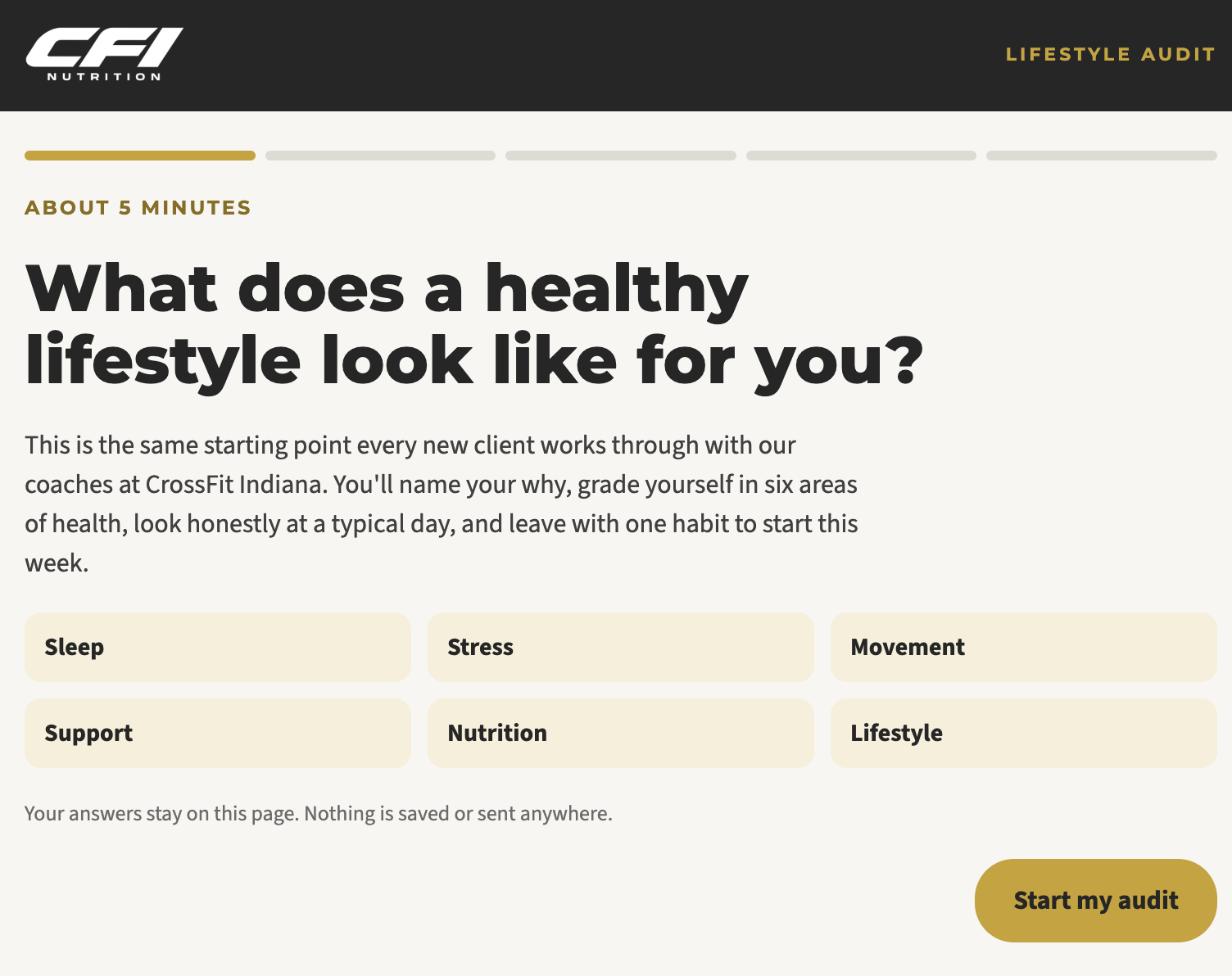
Recently I stood in front of a room full of healthcare professionals and asked a simple question: What makes a healthy lifestyle?
The answers came fast. Eat more vegetables. Sleep more. Exercise. Drink water. Manage stress. Within a minute, the room was full of ideas.
Then I asked a harder one: What gets in the way, even when you know exactly what to do?
That’s when the room got honest. Long shifts. No time to cook. Too tired to work out. Eating whatever’s fastest between commitments. Five hours of sleep, then doing it all again.
Here’s what struck me. These are people who give health advice for a living, and they face the same barriers as everyone else. Knowing what to do is rarely the problem. Knowing where to start, and making it fit your real life, is.
So instead of a lecture, we walked through the same first conversation every new client has with our coaches at CrossFit Indiana. You can do it too, right now. Here’s how it works.
Health is more than what’s on your plate
At CrossFit Indiana, our nutrition coaching is built with Healthy Steps Nutrition, and we never look at food by itself. We look at six areas of health:
- Sleep
- Stress management
- Movement and exercise
- Support system
- Nutrition
- Lifestyle (your routines and environment)
They all affect each other. Short sleep makes cravings louder. Stress pulls you toward the drive-through and away from your workout. A partner who’s on board makes every habit easier. That’s why the best nutrition plan in the world falls apart if the other five areas are on fire.
Step 1: Start with your why
Before we talk about a single food, we ask every client why. People who know the real reason they want to change tend to stick with it when motivation fades.
Try this. Imagine it’s a year from now, and you’re taking care of yourself the way you want to.
- How do you feel?
- What are you doing?
- Who are you with?
Then ask yourself why that matters to you, and to the people you love. Write it down. “I want to lose 20 pounds” is a goal. “I want the energy to play with my kids after work” is a why. The why is what gets you out of bed on a cold morning.
Step 2: Grade yourself, A to F
Next, give yourself a gut-check grade in each of the six areas. Here’s what an “A” looks like:
| Area | What an A looks like |
|---|---|
| Sleep | 7 to 8 hours of quality rest, and you wake up refreshed |
| Stress | Healthy ways to cope that you actually use |
| Movement | 30+ minutes a day, strength training twice a week, 7,000 to 10,000 steps |
| Support | The five people you spend the most time with make healthy choices easier |
| Nutrition | Mostly whole foods and balanced meals |
| Lifestyle | Routines that hold up on a hard week |
When I asked that room to raise their hands if any area got a C or lower, almost every hand went up. That’s every consultation we do. Nobody walks in with straight A’s, and that’s the point. Your lowest grade is usually where to start.
Step 3: Look honestly at yesterday
In every consult we say, “Walk me through what you ate yesterday, from wake-up to bedtime.” Not what it should have looked like. What it actually looked like.
Grab a piece of paper and jot down:
- Food: meals and snacks, and roughly how much
- Drinks: water, coffee, energy drinks, soda, alcohol
- When and how: sitting down, rushed, in the car, standing at the counter
- The rest of your day: how much you slept, how much you moved, and your stress from 1 to 10
Then look at it like a coach would. Don’t judge it, just notice it. Long gaps without food? Three coffees before noon? Most people have never written down a single day, and it’s hard to change something you haven’t looked at.
Step 4: Keep nutrition to three principles
Nutrition doesn’t need to be complicated. Our coaching keeps it to three principles:
- Focus on whole foods first. Meats, eggs, vegetables, fruit, nuts, seeds and beans. Frozen and canned produce count, which matters when you shop once a week.
- Focus on balance. Pair a protein, a carb and a fat at meals and snacks. That combination keeps you full longer and steadies your energy.
- Limit ultra-processed carbs, added sugar and alcohol. No foods are banned. Just notice where these show up most in your day.
The plate method
The simplest way to put balance into practice:
- Half your plate: non-starchy vegetables
- A quarter: lean protein
- A quarter: carbohydrates
- Plus a healthy fat, a little less if your protein already has fat in it
No food scale? Use your hand. Two fists of veggies, one palm of protein, one cupped hand of carbs and a thumb of fat. Your hand goes everywhere you go.
One label trick
The front of a package is marketing. The back is the truth. When you check a label, remember that 4 grams of sugar is about one teaspoon. A flavored yogurt with 16 grams of added sugar has about four teaspoons in it. A plain Greek yogurt with your own berries on top gives you the sweetness without it, plus more protein.
Step 5: Pick one habit, and make it small enough to win
This is where most people go wrong. They see everything they could improve and try to fix it all on Monday. By Thursday, it’s over.
We do the opposite. Look back at your lowest grade and your day, and ask: What’s one habit I feel excited and confident about starting first? Something you could do most days. A few examples:
- Add a palm of protein to breakfast
- Make half your dinner plate vegetables
- Drink a glass of water with every meal
- Take a 10-minute walk after one meal a day
- Set a wind-down alarm 30 minutes before bed
Then plan it out. When will you do it? Who can support you? What’s your backup plan for your worst day?
Last, rate your confidence from 1 to 10. If it’s below a 7, make it smaller. Three days a week becomes two. Two becomes one. A habit you actually do beats an ambitious one you don’t. Once it feels automatic, add the next one.
Take the free Lifestyle Audit
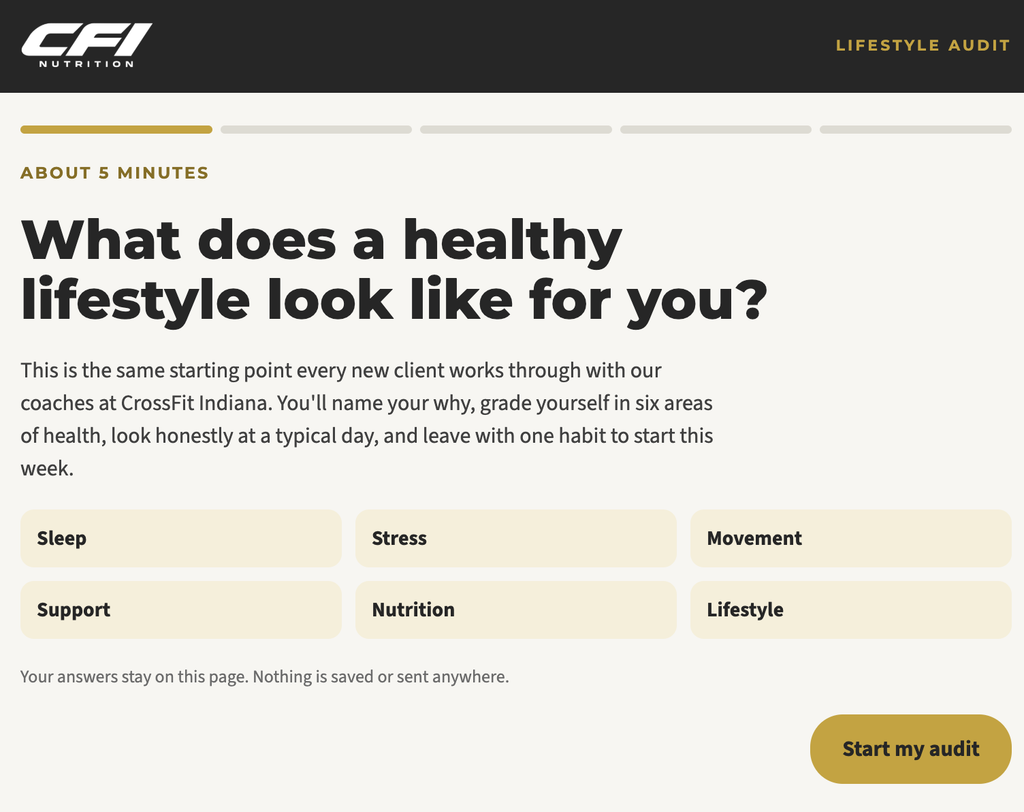
We turned this whole process into a free online Lifestyle Audit. In about five minutes, you’ll name your why, grade yourself in all six areas, look at a typical day, and get three personalized habit ideas based on your answers. No login, and nothing is saved.
Want help turning your results into a plan? At the end of the audit, send your results to us and book a free consultation. We’ll build your first habit around your schedule and check in with you every week.
Not ready for coaching yet? Try the Healthy Steps Nutrition app free for 7 days for habit tracking, recipes and daily lessons.
A healthy lifestyle doesn’t look like perfection. It looks like one small habit you can keep, inside the life you actually live.
This post is for general wellness education and isn’t medical advice. If you have a medical condition that requires a specific diet, talk with your doctor or a registered dietitian.

Coach CJ Lyons, owner of CrossFit Indiana, 1410 Wayne Ave, Suite C, Indiana, PA · 814-929-4535


